TFM Supports Government Initiatives to Reduce Farming Costs Through Clean Energy and Advances the Future of Shrimp Farming
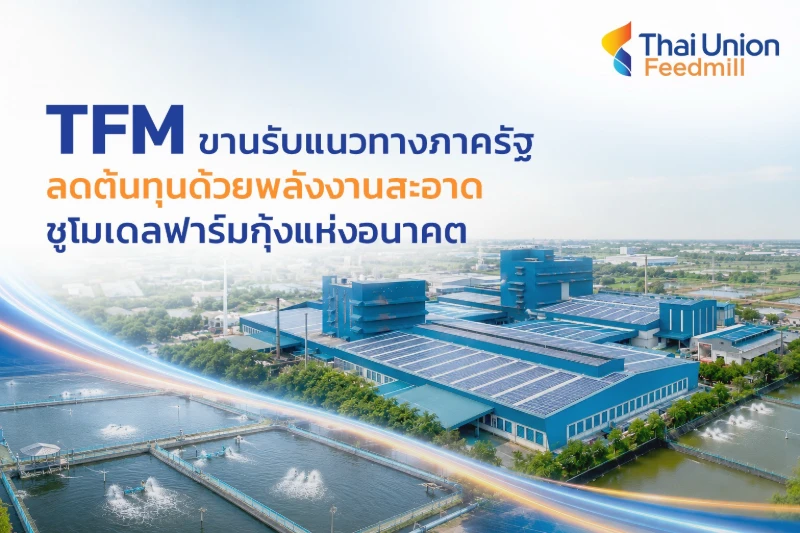
Thai Union Feedmill Public Company Limited (TFM) continues to drive its Sustainability-driven Growth strategy to address the growing challenges posed by climate change, which is creating increasingly significant structural impacts on the aquaculture industry, affecting production efficiency, farming costs, and the stability of farmers' income. These challenges have become key issues for the long-term development of Thailand's shrimp industry.
The government has accelerated efforts to strengthen the competitiveness of Thailand's shrimp industry. These efforts include expanding market access, restructuring production costs through the promotion of solar energy (solar cell) adoption in shrimp farms, developing the "Thai Shrimp" brand to enhance product value and strengthen its image, as well as expanding both domestic and international markets to improve the industry's long-term competitiveness. These efforts are closely aligned with TFM's commitment to leveraging innovation, technology, and technical expertise to help reduce farming costs, improve production efficiency, and continuously enhance the capabilities of Thai shrimp farmers.
Mr. Peerasak Boonmeechote, Chief Executive Officer of Thai Union Feedmill Public Company Limited, said: "Climate change is creating significant challenges for the aquaculture industry. Today, strengthening the industry's competitiveness requires more than effective cost management. It requires the integration of scientific knowledge, technology, and innovation to improve production efficiency, reduce costs, and strengthen the resilience of both farmers and the industry, while supporting sustainable long-term growth."
Global warming has led to greater fluctuations in water temperatures, directly affecting pond ecosystems, including dissolved oxygen levels, the feeding behaviour of aquatic species, and the risk of disease outbreaks. These factors directly impact production efficiency, farming costs, and farmers' profitability.
To address these challenges, TFM has strengthened the role of its Technical Service Team by working closely with farmers in the field. The team applies scientific knowledge and technological solutions to help increase productivity, reduce losses, lower farming costs, and improve farm management efficiency, ultimately enhancing farmers' income and long-term competitiveness.
In line with the government's efforts to strengthen the capabilities of Thai farmers, TFM also promotes Lower Carbon Aquaculture by supporting the adoption of solar energy (solar cell) systems in shrimp farms, together with automated feeding systems and advanced farm management technologies. These initiatives help reduce energy costs, improve production efficiency, and lower greenhouse gas emissions throughout the aquaculture value chain.
In addition, TFM continues to invest in technology and innovation, including digitalization, automation, and Artificial Intelligence (AI) across its manufacturing processes and factory management systems. These investments enhance operational efficiency, strengthen the Company's cost competitiveness, and improve its ability to respond to market volatility and future industry changes.
The Company remains committed to its strategy of being a cost-efficient, high-quality aquaculture feed producer, while continuing to advance the future shrimp farming model through technology, innovation, and sustainability. Through these efforts, TFM aims to strengthen the long-term competitiveness of Thailand's shrimp industry and support its sustainable growth on the global stage.