TFM Secures Halal Certification, Expands into Halal Aquafeed Market to Meet Growing Demand in the Middle East and ASEAN, Driving International Growth
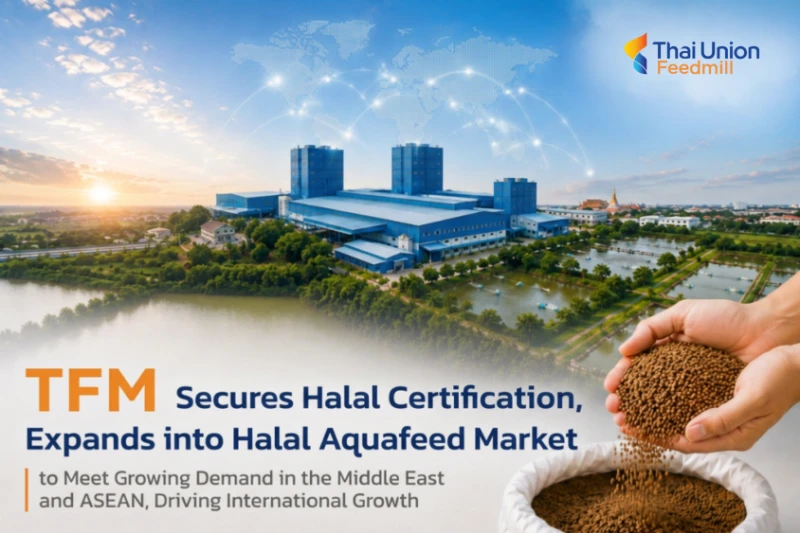
Thai Union Feedmill Public Company Limited (TFM) has secured Halal Certification, further strengthening its production standards in quality, safety, and traceability while enhancing its competitiveness in the aquafeed market. The certification also supports TFM’sexpansion into the halal aquafeed market, enabling the Company to broaden its customer base and capture growing opportunities in the Middle East and ASEAN, while creating new opportunities in international markets and reinforcing its position as a leading aquafeed producer in the region.
Mr. Peerasak Boonmeechote, Chief Executive Officer of Thai Union Feedmill Public Company Limited (TFM), a Thai manufacturer and distributor of aquafeed and livestock feed, said that the Company has received Halal Certification from the Central Islamic Council of Thailand, covering 48 SKUs of shrimp and fish feed products. The certification marks an important step in enhancing TFM’s product standards and readiness to serve markets where halal standards are highly valued, particularly in the Middle East and ASEAN, as well as among customers who place importance on quality,safety and internationally recognized standards.
TFM places strong emphasis on comprehensive quality control across its operations, from the selection and management of raw materials and collaboration with suppliers and business partners to production processes and personnel management. These practices help ensure compliance with the requirements of the Halal Assurance System. This is particularly important to the aquaculture supply chain, especially for farms and processing operators that export to Muslim markets, where the concept of “Halal from Farm to Table” is increasingly important. The concept covers the entire supply chain, from the feed used in aquaculture production through to finished products. Halal Certification therefore helps strengthen confidence among farmers, operators, business partners, and customers across the value chain.
In addition, the certification enhances TFM’s competitiveness and creates opportunities to reach a broader customer base, including industrial-scale aquaculture farms and integrated aquaculture operators that place importance on quality, safety, and traceability. It also supports further market expansion into high-potential markets, particularly in the Middle East, Malaysia, and Bangladesh.
At the same time, the aquafeed market continues to benefit from seasonal demand, particularly around major religious occasions such as Ramadan and Hari Raya (Eid al-Fitr / Eid al-Adha) when aquaculture operators typically plan their farming cycles and place feed orders in advance to meet anticipated market demand. Meanwhile, many countries are accelerating the development of their aquaculture industries to strengthen food security and reduce reliance on imports. These trends create opportunities for TFM to leverage its Halal Certification to expand its customer base, respond to demand in high-potential markets, and increase its presence and revenue opportunities in international markets over the long term.
As part of its next phase of development, TFM plans to extend Halal Certification to its Ranot plant in Songkhla Province to enhance its capacity to serve customers in southern Thailand and overseas markets. This expansion will be carried out alongside the Company’s operations under Thai Union Group’s SeaChange® 2030 strategy, which aims to drive sustainable growth through quality, innovation, and international standards.
“With our commitment to elevating product quality and production standards to an international requirements, TFM became the first aquafeed manufacturing facility in Asia to achieve ASC Feed certification, a global standard for responsible aquafeed production. Together with Halal Certification, these certifications further strengthens our competitiveness and creates opportunities to reach new customers and international markets,. This is an important step toward our goal of becoming a leading aquafeed producer in the region while delivering sustainable long-term growth,” Mr. Peerasak concluded.