Thai Union Feedmill Joins Forces with Public and Private Sectors and Farmers Launches “Thai Union Synergy 2026” to Strengthen Thai Shrimp Potential toward a Low-Carbon Future
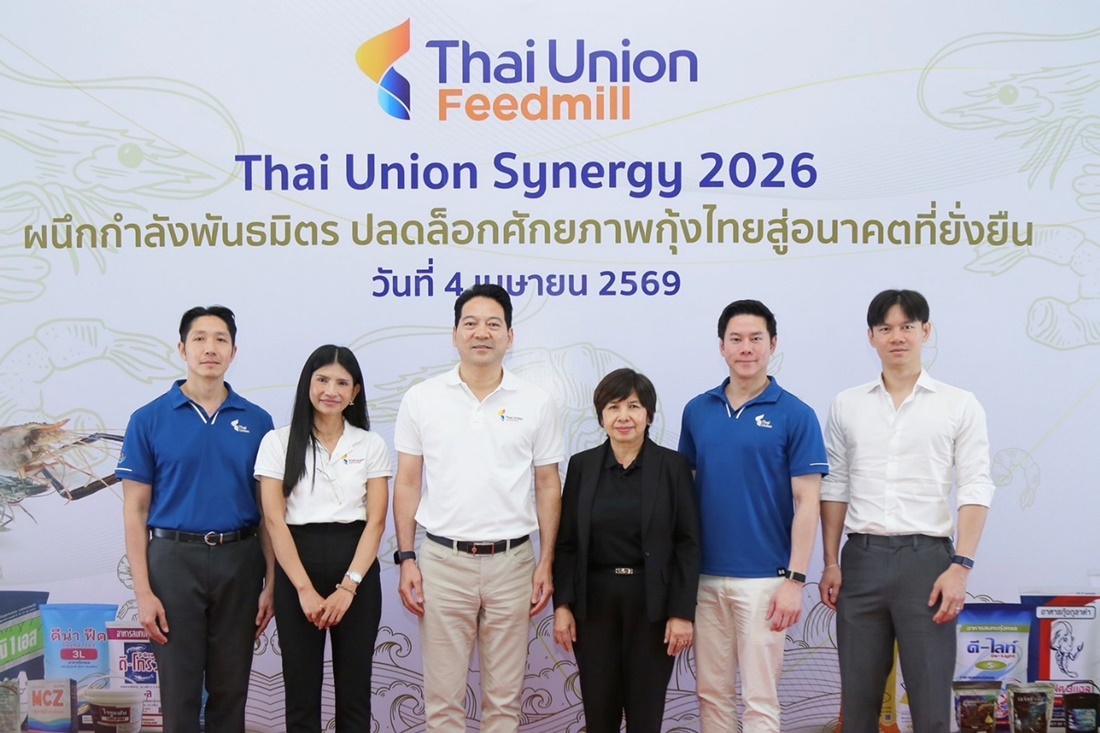
Thai Union Feedmill Public Company Limited (TFM), a member of the Thai Union Group, has officially launched the event “Thai Union Synergy 2026”, bringing together partners across the shrimp industry ecosystem—including government agencies, private-sector stakeholders, and farmers—to share knowledge, exchange strategic perspectives, and jointly define the direction of Thailand’s shrimp industry in 2026.
The event takes place amid significant challenges facing the industry, including volatile production costs, uncertainty in global supply, and increasing environmental pressure. At the same time, new opportunities are emerging from premium markets and sustainable consumption trends, opening pathways for Thai operators to further enhance their competitiveness.
Mr. Peerasak Boonmechote, Chief Executive Officer of Thai Union Feedmill PCL, stated that under the current challenges confronting the Thai shrimp industry, enhancing competitiveness is at the core of sustainable business operations. This requires collaboration across the entire value chain—from upstream to downstream—to create long-term balance in costs, efficiency, and market access. These factors form the foundation of the “Thai Union Synergy 2026” event, organized under the concept of leveraging partnerships to unlock the potential of Thai shrimp toward a sustainable future. The event attracted strong participation from shrimp farmers, the Department of Fisheries, and industry partners.
From a market structure perspective, demand within the Thai shrimp industry varies according to end-market consumption. Key demand lies in shrimp sizes of 50–70 pieces per kilogram, and 20–50 pieces per kilogram for specific segments. Part of this production serves domestic consumption, while the remainder are linked to export markets. Overseas markets—especially the United States and Europe—are increasingly emphasizing processed and value-added products to meet expectations for quality, standards, and sustainability throughout the supply chain.
Ms. Montakarn Thamtin, Director of the Coastal Aquaculture Research and Development Division, Department of Fisheries, noted that the Thai shrimp industry is facing structural pressure from a global resource crisis. Currently, humanity consumes natural resources at approximately 1.7 times the Earth’s capacity to regenerate, while Thailand exceeds its ecosystem capacity by as much as 85%.
Thailand has recently announced an accelerated timeline toward carbon neutrality, targeting Net Zero by 2050 and a 47% reduction in greenhouse gas emissions by 2035, underscoring the urgency for adaptation across all sectors.
The Department of Fisheries emphasized that carbon footprint is becoming a new cost factor in global trade. In particular, the European Union has begun enforcing the Carbon Border Adjustment Mechanism (CBAM), or “carbon border tax,” which imposes fees on imported goods with high greenhouse gas emissions. This measure initially covers key industries such as cement, electricity, fertilizers, steel, aluminum, and hydrogen. Although products such as shrimp are not included in the first phase, indirect impacts may arise through higher costs along the supply chain—especially in energy and feed. There is also a possibility that the scope of the measure will expand in the future, potentially affecting Thailand’s food industry and exports. In this regard, the Department of Fisheries is ready to collaborate with the private sector and partners to promote low-carbon shrimp farm initiatives, enhancing farmer capabilities and driving sustainable industry growth.
Mr. Prad Kerdpairoj, Director of Sustainability for Pet Food, Aquafeed, and Marine ingredients Businesses at Thai Union Group PCL (TU), stated that the Thai shrimp industry is accelerating its transition toward Low Carbon Aquaculture to meet global market demand, particularly from major buyers in the U.S. and Europe. The main sources of greenhouse gas emissions come from feed production and on-farm management.
The Thai Union Group is therefore advancing its SeaChange® 2030 strategy, driving greenhouse gas reduction across the entire supply chain. This includes pilot projects focused on strengthening farmers’ knowledge in farm management, such as shrimp feed management and the use of alternative energy sources—particularly solar energy—to reduce energy costs. The company is also using feed ingredients sourced from deforestation-free supply chains, with a target to reduce greenhouse gas emissions by 25–35%.
In addition, the company is applying technology and data to improve farming efficiency while developing low-carbon solutions, such as alternative proteins and improvements in Feed Conversion Ratio (FCR). These initiatives are planned for nationwide expansion to create a network of low-carbon shrimp production that complies with international standards such as Best Aquaculture Practices (BAP) and Aquaculture Stewardship Council (ASC) certifications, which play a crucial role in accessing premium markets over the long term.
At the global competitive level, the Thai shrimp industry is adapting by avoiding price competition with large producers that benefit from lower raw material costs. Instead, it is focusing on quality enhancement, stringent food safety controls, avoidance of prohibited residues, and the development of fully traceable production systems throughout the supply chain. These efforts are coupled with the development of value-added products and low-carbon shrimp concepts to create differentiation and strengthen competitiveness in global trade.
Mr. Peerasak concluded that the concept of “Synergy to Success” serves as a key mechanism to integrate collaboration across the entire value chain—enhancing efficiency, reducing costs, and creating value throughout the system. The ultimate goal is to ensure that “farmers can sustain their livelihoods” while driving the Thai shrimp industry toward long-term sustainability.
Although shrimp prices in Thailand in 2025 remain relatively high—reflecting strengths in product quality—exports continue to face pressure. Export volumes declined to 129,308 tons, the lowest level in 18 years, down from a peak of 388,455 tons in 2011, while export value stood at approximately 40,889 billion baht. This situation highlights the urgent need to improve production efficiency, particularly at the farm level, which is the starting point of the entire supply chain. This represents a critical role for TFM in strengthening the long-term competitiveness of Thai farmers.
At the same time, raising production standards to international levels remains essential. TFM is the first feed mill in Asia to receive ASC Feed certification, reflecting the direction of Thailand’s shrimp industry toward sustainability and global market acceptance.
The company continues to build a strong ecosystem spanning upstream to downstream operations, focusing on knowledge enhancement and innovation to drive the Thai shrimp industry toward sustainable global competitiveness by leveraging the strengths of both regional and international networks.